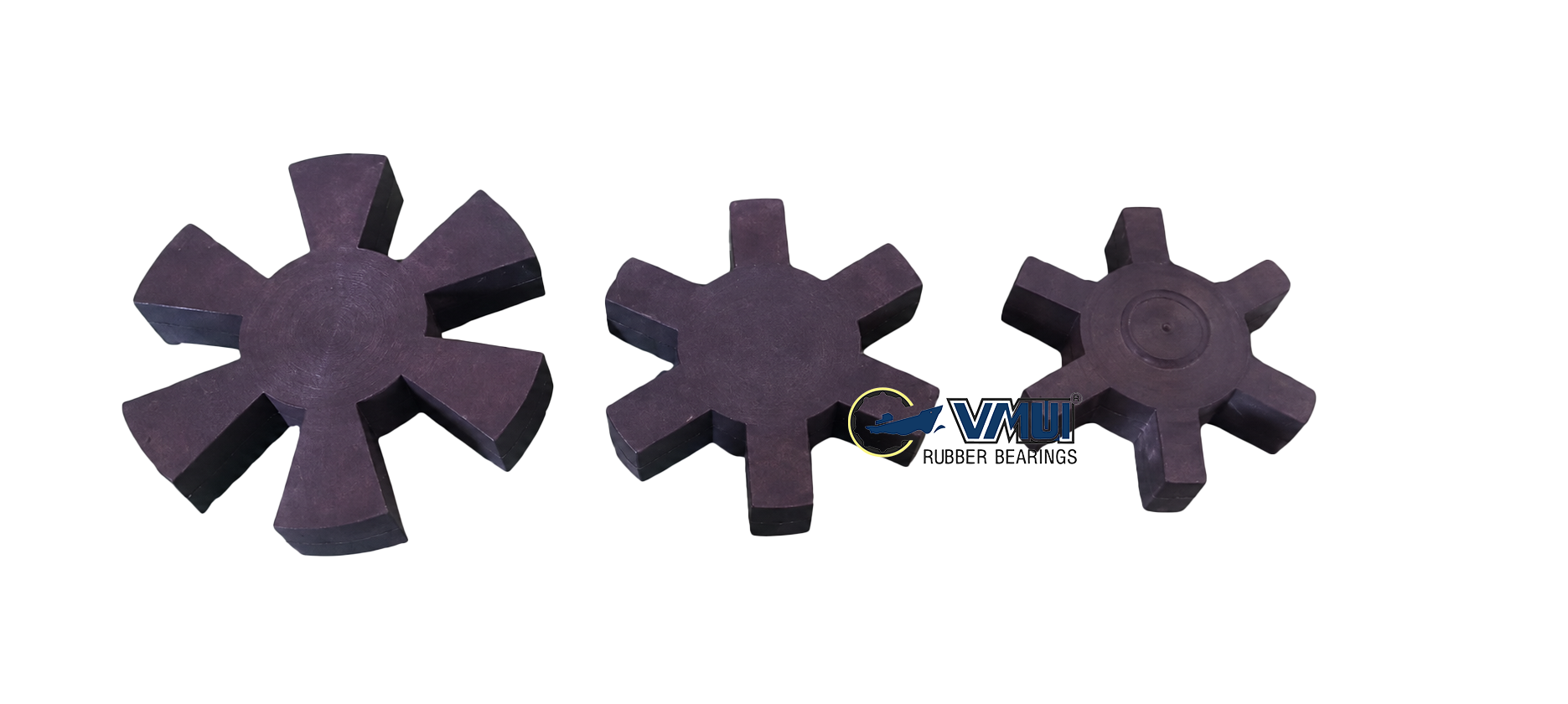
The Six-Arm Rubber Coupling Spider, also known as a six-arm coupling damper, is an elastic element installed between two jaw coupling hubs in a power transmission system. It transmits torque, absorbs impact loads, and reduces vibration between the motor shaft and the driven equipment shaft.
The product consists of a solid central body and six evenly spaced straight arms. These rubber arms fit between the jaws of the two coupling hubs, forming an elastic buffer that prevents direct metal-to-metal contact during operation.
The Six-Arm Rubber Coupling Spider features a one-piece molded construction with six radial arms. Each arm is shaped to fit the space between the metal coupling jaws, ensuring proper engagement and stable torque transmission.
When the coupling rotates, the driving jaws compress the rubber arms and transfer torque to the other shaft. The elastic deformation of the rubber helps absorb torsional vibration and impact forces generated during startup, shutdown, or sudden load changes.
Its straight-arm design also distinguishes it from curved-arm, round-lobe, elliptical-lobe, and plum-shaped coupling spiders commonly available on the market.
The product performs several important functions within a power transmission assembly:
If the metal coupling hubs remain in good condition, the rubber spider can be inspected and replaced separately without replacing the entire coupling assembly.
Depending on the operating environment, the Six-Arm Rubber Coupling Spider can be manufactured from various engineering rubber compounds:
The appropriate rubber compound, hardness, and formulation should be selected according to the required torque, operating speed, impact load, temperature, and contact environment.
Six-Arm Rubber Coupling Spiders are widely used in industrial power transmission systems, including:
After extended operation, the rubber element may harden, crack, wear, or deform due to repeated loading, heat, oil, chemicals, and environmental exposure. Common warning signs include:
Regular inspection and timely replacement can help prevent damage to the shafts, bearings, seals, and other connected components.
Six-Arm Rubber Coupling Spiders can be manufactured according to an existing sample, technical drawing, or customer-specified dimensions. The size, arm profile, rubber material, and hardness can be customized to match different coupling designs and operating conditions.
The main information required for production includes the outside diameter, diameter at the base of the arms, overall thickness, arm width, mating jaw dimensions, rubber material, hardness, and operating environment.
Because products with the same coupling code may have different dimensions depending on the manufacturer, comparing the required part with an existing sample or technical drawing is recommended to ensure proper compatibility with the coupling hubs.