PU rubber (Polyurethane), also known as Polyurethane Rubber or Polyurethane Elastomer, is a synthetic polymer material that combines the elasticity of rubber with the mechanical strength of engineering plastics. This material is known for its excellent abrasion resistance, load-bearing capacity, tear resistance, and impact resistance, making it widely used in various industrial applications.
Polyurethane was first developed in 1937 by German chemist Otto Bayer and his colleagues. Through continuous research and development, PU has become an important group of materials used in manufacturing machinery components, industrial equipment, automotive parts, mining equipment, and many other applications.
Unlike natural rubber or conventional synthetic rubbers such as NBR, EPDM, and CR, PU belongs to a group of polymers containing urethane linkages within their molecular structure. By adjusting the raw material composition and manufacturing formulation, polyurethane can be produced in various forms, ranging from soft and elastic materials to rigid materials.
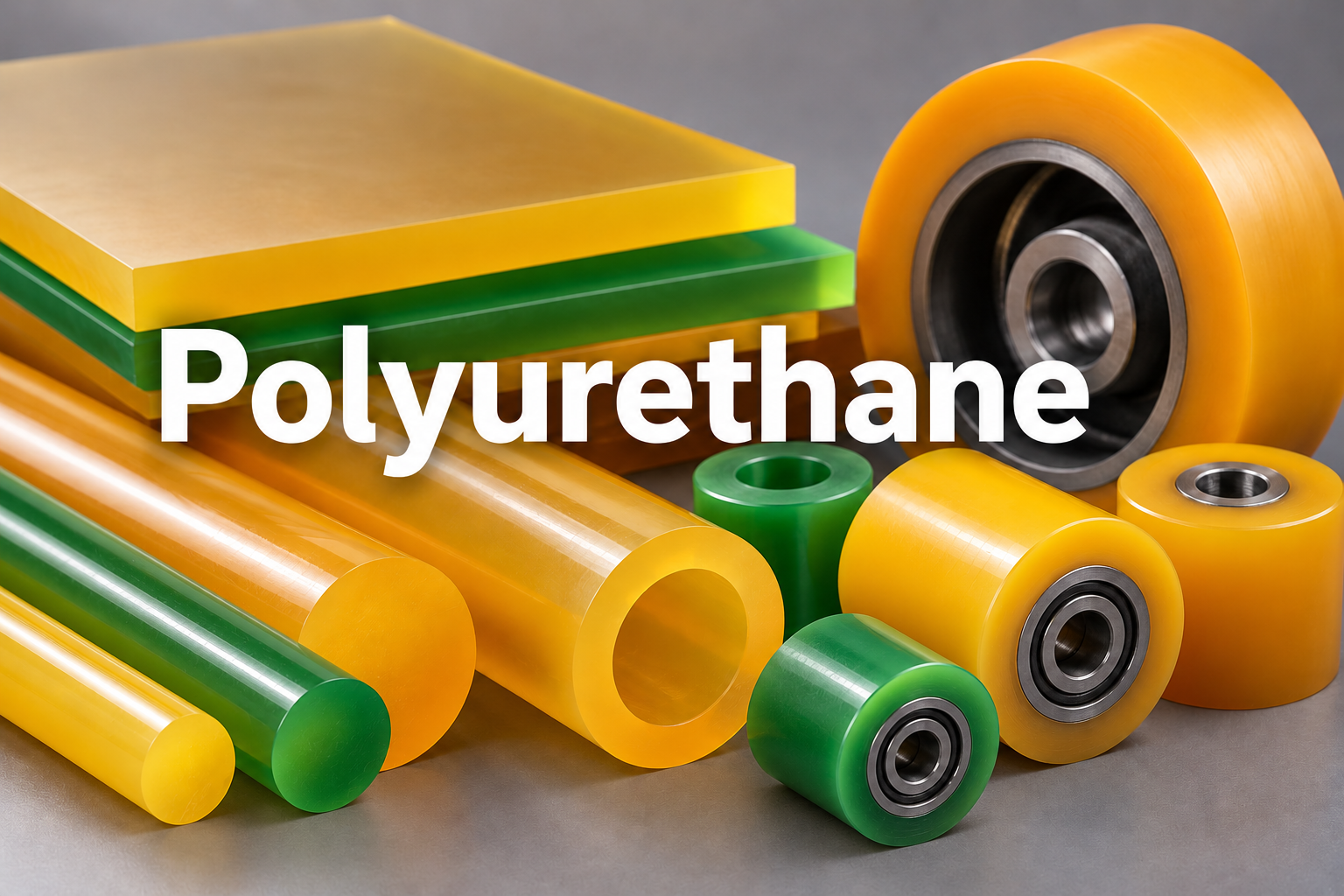
In the industrial rubber sector, PU is commonly used in the form of Polyurethane Elastomer, which is suitable for manufacturing products such as rollers, wheels, PU sheets, sealing gaskets, shock-absorbing pads, and wear-resistant components.
Polyurethane is primarily formed through an addition reaction between compounds containing isocyanate groups (–NCO) and compounds containing hydroxyl groups (–OH), creating characteristic urethane linkages.
The chemical structure of a urethane linkage is:

For industrial polyurethane elastomers, the raw material system generally consists of three main components:
For a simple linear polyurethane system formed from diols and diisocyanates, the reaction can be represented as follows:

Here, R and R′ represent organic groups derived from diisocyanates and diols, respectively. This is a general structural representation rather than a fixed molecular formula applicable to all types of PU.
The structure of polyurethane elastomers consists of two main types of segments:
The distribution and interaction between soft and hard segments create the characteristic mechanical properties of PU. By modifying the proportions and composition of raw materials, manufacturers can adjust hardness, elasticity, abrasion resistance, and other properties to meet specific application requirements.
Based on the polyol composition, polyurethane elastomers are generally classified into two main groups:
Polyether-Based Polyurethane
Polyether-based PU offers better hydrolysis resistance than many conventional polyester-based PU systems while maintaining good flexibility under low-temperature conditions. This material is suitable for applications involving high humidity, frequent water exposure, or requirements for elasticity.
Polyester-Based Polyurethane
Polyester-based PU generally provides good mechanical strength, abrasion resistance, and tear resistance. Certain formulations also exhibit suitable resistance to oils and solvents for industrial applications. However, this material may undergo hydrolysis when exposed to water for extended periods, particularly at elevated temperatures.
In addition, based on processing methods, polyurethane elastomers can be classified into Cast Polyurethane and Thermoplastic Polyurethane (TPU). Each type has its own manufacturing characteristics and application range.
PU rubber is widely used in industrial applications due to its combination of mechanical strength, elasticity, and abrasion resistance. Some of its outstanding properties include:
|
Property |
Typical Reference Value |
|
Density |
Approx. 1.1 – 1.3 g/cm³ |
|
Common Hardness Range |
50 – 95 Shore A |
|
Tensile Strength |
Approx. 20 – 50 MPa |
|
Elongation at Break |
Approx. 300 – 700% |
|
Typical Operating Temperature |
-30°C to 80°C |
|
Abrasion Resistance |
Good to excellent, depending on formulation |
|
Tear Resistance |
Good to excellent, depending on formulation |
|
Oil and Grease Resistance |
Good resistance to many common oils and greases, depending on formulation |
Note: The values above are reference ranges for certain industrial polyurethane elastomers and do not represent specifications applicable to all types of polyurethane. PU can also be manufactured with hardness levels outside these ranges, including Shore D grades. Exact specifications depend on the material type, formulation, and technical datasheet of each product.
Despite its advantages in durability and abrasion resistance, PU also has certain limitations that should be considered:
Therefore, when selecting PU rubber for industrial applications, it is essential to consider the load requirements, operating temperature, exposure environment, and actual working conditions.
Thanks to its abrasion resistance, load-bearing capacity, and excellent mechanical strength, PU rubber is widely used in various manufacturing industries and industrial machinery applications.
PU is commonly used to manufacture conveyor rollers, guide wheels, roller coverings, conveyor belt scrapers, and components that come into direct contact with materials during transportation.
The abrasion resistance and load-bearing capacity of PU help these components maintain effective performance in environments involving continuous friction. In addition, the material's elasticity contributes to impact reduction, noise reduction, and protection of contact surfaces during operation.
PU products can be designed with different hardness levels, dimensions, and shapes to suit various machinery systems.
In the mining, construction materials, and granular material processing industries, PU is used for components requiring abrasion and impact resistance.
Common products include PU screening panels, wear-resistant liners, scraper blades, hopper liners, and components that come into direct contact with sand, stone, ores, or other abrasive materials.
Thanks to its elasticity and abrasion resistance, PU can help minimize surface damage, reduce impact noise, and extend component service life under suitable operating conditions.
PU is one of the commonly used materials for manufacturing load-bearing wheels, forklift wheels, industrial trolley wheels, guide rollers, and drive rollers.
Compared with many rigid materials, the elastic PU layer can absorb part of the impact force and reduce noise when contacting operating surfaces. At the same time, its mechanical strength and load-bearing capacity make it suitable for material handling systems and industrial equipment.
Depending on the application, the PU layer can be manufactured with different hardness levels and combined with a metal core to meet requirements for load capacity, traction, and product durability.
PU is also used to manufacture hydraulic seals, wiper seals, sealing gaskets, and components for hydraulic or pneumatic systems.
Thanks to its abrasion resistance, tear resistance, and pressure-bearing capability, PU is suitable for various sealing applications involving relative movement between contacting surfaces.
In particular, technical PU seals are selected for systems requiring abrasion resistance and mechanical durability during continuous equipment operation.
However, selecting the appropriate PU material for sealing applications requires consideration of pressure, temperature, movement speed, and operating fluids.
In addition to the applications mentioned above, PU is also used to manufacture shock-absorbing pads, bushings, load-bearing washers, flexible coupling elements, and transmission components.
Its combination of elasticity and mechanical strength enables PU to absorb part of the impact energy, reduce vibrations, and minimize direct contact between metal components.
PU components can be designed in various shapes and hardness levels to meet the requirements of different equipment systems.
With over 20 years of experience in manufacturing technical rubber products, Anh Tri Tue Company provides custom manufacturing solutions for PU (Polyurethane) components, supporting the operation, maintenance, and replacement of machinery parts across various industries.
Technical PU products include PU rollers, PU wheels, wear-resistant PU sheets, PU gaskets and seals, shock-absorbing pads, bushings, coupling components, and specially shaped products.
Depending on specific application requirements, products can be customized in terms of hardness, dimensions, shapes, and suitable PU material types to match actual working conditions.
Anh Tri Tue Company focuses on custom manufacturing solutions based on technical drawings or physical samples, meeting requirements for dimensional accuracy, material performance, and compatibility with machinery systems.
Selecting the appropriate PU material and manufacturing method helps ensure that products meet the requirements for abrasion resistance, load-bearing capacity, and durability during operation, contributing to improved equipment efficiency and reduced maintenance and component replacement costs.