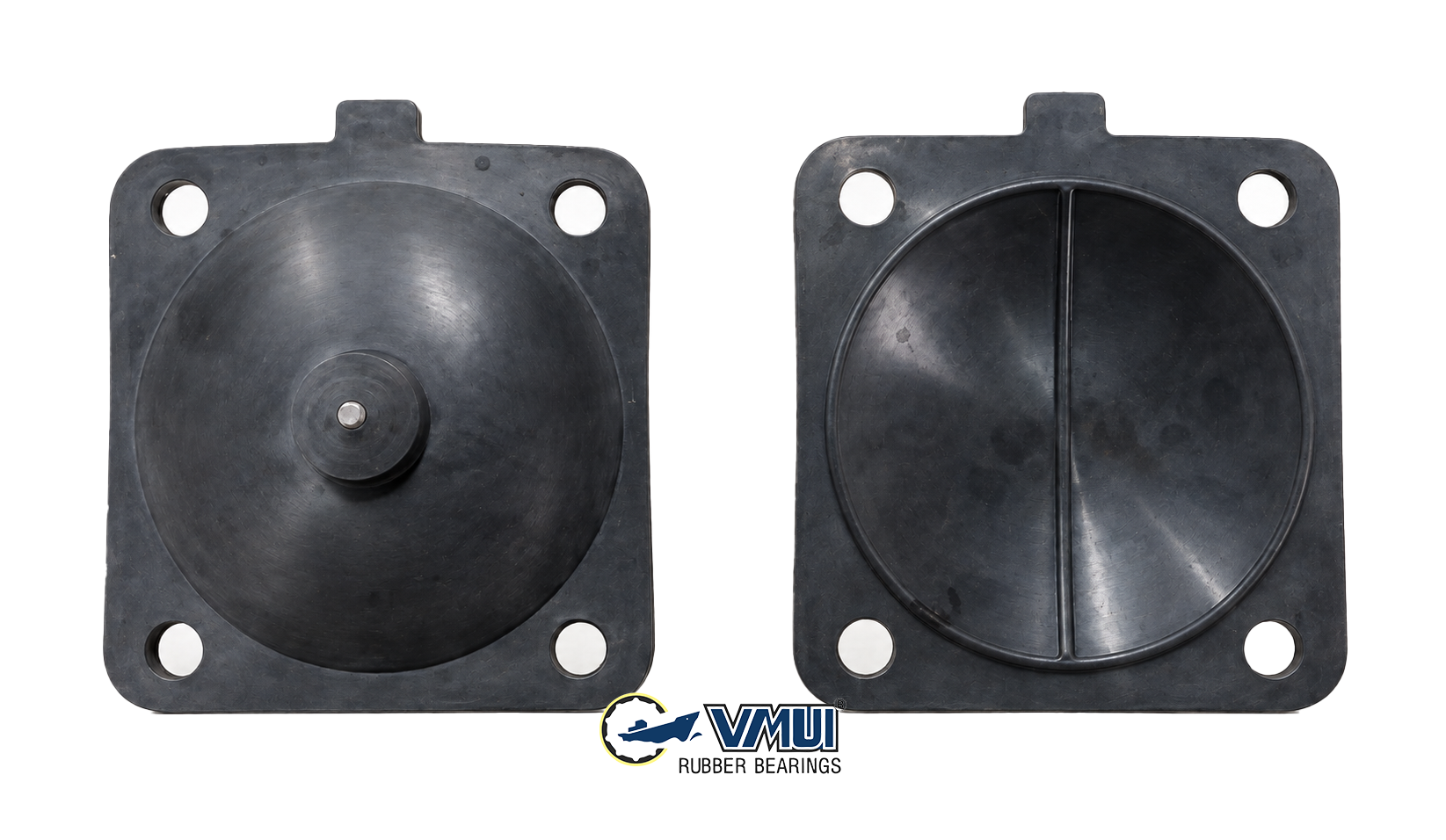
A square rubber valve diaphragm is a flexible sealing and actuation component used in industrial diaphragm valves, control valves, and fluid-handling systems. Featuring four mounting holes at the corners and a flexible working area in the center, the diaphragm supports valve opening and closing, flow control, and leakage prevention. Anh Tri Tue manufactures custom rubber diaphragms based on samples, technical drawings, and actual operating conditions.
A square rubber valve diaphragm is an engineered rubber component installed between the valve body and bonnet. Its outer edge is clamped in place by bolts, while the central working area flexes, moves, and returns to its original position under pressure or mechanical actuation.
During operation, the center of the diaphragm moves to open, close, or regulate the fluid passage. At the same time, it forms a barrier between the process medium and the actuator, helping prevent liquids or gases from reaching the valve stem and other mechanical components.
Unlike a static rubber gasket, a valve diaphragm must maintain a reliable seal while repeatedly flexing during operation. Its performance therefore depends on its geometry, thickness, hardness, rubber compound, working-area design, and actual service conditions.
The diaphragm has a square profile with four holes positioned at the corners. These holes are used to mount and locate the diaphragm within the valve assembly; they are not fluid passages.
The four-hole design serves several important purposes:
The central area is typically molded into a domed shape, providing sufficient flexibility and travel under pressure. Depending on the valve design, this area may incorporate a rubber boss, pin, stud, or another connection feature that links the diaphragm to the valve operating mechanism.
The hole diameter, center-to-center spacing, and distance from the holes to the outer edge must match the valve assembly. Incorrect hole positions may cause uneven clamping, wrinkling, misalignment, or tearing around the mounting holes.
Depending on the valve and equipment design, the diaphragm can perform one or more of the following functions:
When pressure or an actuator applies force, the central working area moves accordingly. As the force changes, the elasticity of the rubber allows the diaphragm to recover or work together with other valve components to return the valve to the required position.
The rubber diaphragm directly controls the opening and closing of the fluid passage. Its design isolates the process medium from the valve stem and operating mechanism while maintaining an effective seal during operation.
The diaphragm receives force from gas or liquid pressure and transfers it to the valve mechanism, supporting the regulation of flow and pressure within the system.
In pneumatic valve assemblies, the diaphragm can separate air chambers, transmit force, and control the opening or closing position in response to pressure changes.
A flexible diaphragm can generate suction and discharge movement while isolating the pumped medium from the mechanical drive components.
Rubber valve diaphragms are used in systems handling water, air, and treatment solutions. Applications involving chemicals, solids, or deposits require a suitable rubber compound and diaphragm construction.
Square rubber diaphragms are also used in compressors, automation equipment, chemical-processing systems, mechanical equipment, and specialized valve assemblies.
No single rubber compound is suitable for every operating environment. Material selection should be based on the process medium, temperature, pressure, diaphragm travel, and operating cycle rate.
Common materials include:
Two diaphragms with the same appearance may require different rubber compounds when used with different media or under different service conditions. Material selection should therefore not be based only on the color or appearance of the original part.
Anh Tri Tue manufactures square rubber valve diaphragms based on physical samples, technical drawings, or valve assembly specifications. Customizable features include:
The square four-hole design is a common configuration, but it does not limit our manufacturing capability. The number of holes, hole positions, profile, and complete diaphragm geometry can be customized to match different valve designs.
For imported equipment, discontinued models, or parts that are difficult to source, customers may provide an existing diaphragm for dimensional inspection and replacement-part development.
A valve diaphragm should be inspected or replaced when the equipment shows any of the following signs:
In addition to matching the original geometry, the cause of failure should be evaluated so that the rubber compound, hardness, or reinforcement structure can be improved when necessary.
Customers may provide an existing sample or technical drawing, equipment or valve model, process medium, operating temperature and pressure, and the required quantity. This information helps Anh Tri Tue recommend a suitable rubber compound and diaphragm construction.